Analog-Aware Placement
The generated analog modules are treated as hierarchical placement blocks rather than being flattened into individual devices.
Each block enters placement with an effective placement footprint and selected structural metadata. The placement stage then combines a generic B*-tree floorplanning representation with several initialization strategies that reflect analog structure, device polarity, circuit role, and well-domain relations.
The objective is not to encode one fixed op-amp floorplan. Instead, multiple candidate organizations are generated and optimized, allowing generic compactness and analog-aware preferences to compete within the same search framework.
B*-Tree Representation
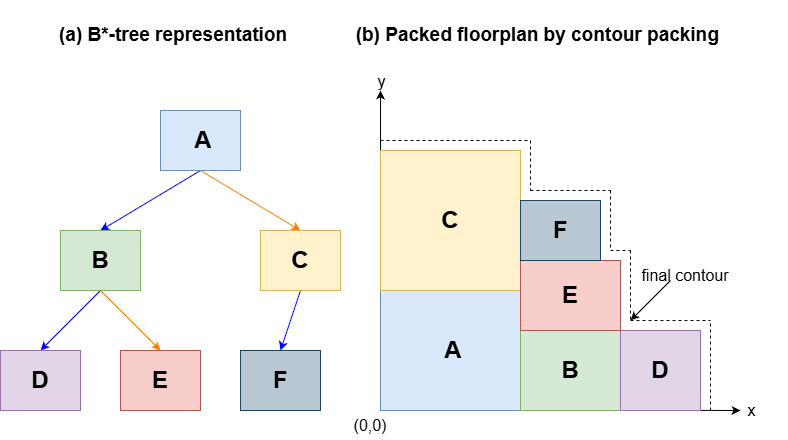
A B*-tree represents the relative placement of rectangular or footprint-based modules using parent–child relations.
In the adopted convention:
- the left child is placed to the right of its parent;
- the right child starts from the parent’s horizontal position and is packed above the existing contour.
For a parent module P:
P.left = Ameans that module A begins at the right boundary of P;P.right = Bmeans that module B is placed at the same starting x-coordinate as P, with its vertical position determined by the current contour.
The tree therefore defines horizontal placement relations, while contour packing determines the lowest legal vertical position that avoids overlap.
This representation provides a compact combinatorial search space while allowing the actual module dimensions and placement footprints to remain unchanged.
Placement Footprints
The placer operates on the effective placement geometry exported by each generated module.
The effective footprint can account for:
- the generated module boundary;
- module-specific placement margins;
- additional spacing required around selected module classes;
- non-rectangular placement descriptions represented through a compact placement abstraction.
This separation allows local analog layout structure to remain inside the generated child cell while the top-level placer works only with the geometry required for packing and spacing.
Multistart Strategy
A single initial B*-tree can strongly influence the result of a local search. The placement stage therefore evaluates multiple initial topologies.
The implementation contains both generic baseline seeds and analog-aware seeds.
Generic Seeds
Generic seeds provide topology-independent starting points, including:
- a simple left-chain organization;
- global area-descending ordering;
- a balanced area-descending tree;
- row-aware area-descending placement;
- stage-aware balanced variants.
These seeds provide baseline solutions and reduce dependence on analog-specific assumption.
Same-Well Seeds
When modules belong to the same n-well domain, two explicit orientation seeds are available.
Same-well horizontal
Modules belonging to the same n-well cluster are initialized as a left-chain. Under the adopted B*-tree setup, this produces a row-like horizontal organization that is suitable for a local horizontal n-well bridge.
Same-well vertical
The same cluster is initialized as a right-chain, producing a vertical stack-like candidate suitable for a vertical n-well connection.
These initialization strategies provide the optimizer with physically meaningful candidate topologies while the objective function determines whether the resulting placement remains competitive.
For the same-well-oriented and analog-row seeds, the corresponding same-nwell clusters are preserved during local search so that a candidate is not destroyed by moving only part of the cluster.
Analog-Row-Compact Seed
The analog-row-compact seed is a circuit-aware initialization intended for small two-stage op-amp structures when the required module roles have been recognized.
It uses structure and polarity information to construct an initial organization around roles such as:
- the differential-pair core;
- current-mirror or bias structures;
- power-connected PMOS modules;
- grounded NMOS modules;
- second-stage or side modules;
- the compensation capacitor.
The purpose of this seed is to provide a compact, routing-relevant analog starting point while not to impose a hard template.
If the expected analog-role pattern is not recognized, the implementation falls back to the generic row-stack seed instead of forcing the circuit-specific organization.
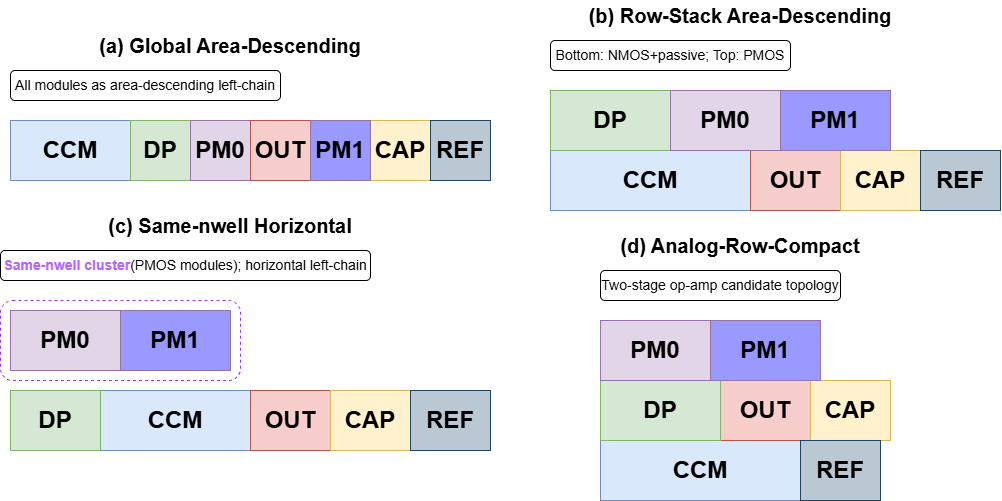
Abbreviations: CCM = current-mirror-related module, e.g. cascode current mirror; DP = differential-pair module; PM0/PM1 = same-nwell PMOS modules; OUT = output-related module; CAP = compensation capacitor; REF = remaining side/reference module.
Local Search
Each seed is improved using a best-improvement hybrid hill-climbing search.
At every iteration, two neighborhood classes are evaluated.
Subtree Detach–Reattach
A non-root B*-tree subtree can be detached and reattached to another available parent position as either a left or right child.
This changes the relative placement topology while preserving all modules inside the moved subtree.
Node-Label Swap
Two B*-tree nodes can exchange their associated module labels while the tree topology itself remains unchanged.
This allows the search to test a different assignment of physical modules to the same relative placement structure.
For each iteration, the search evaluates the available candidates from both move classes and applies the move with the lowest improved objective cost.
The process stops when no evaluated move improves the current solution or when the configured iteration limit is reached.
Generic module rotation is not used as a neighborhood move in the reported implementation. Generated modules retain their orientation and are not allowed to freely rotate during B*-tree search.
Placement Objective
Placement quality is evaluated using a weighted objective.
The implemented cost model combines several classes of consideration:
| Objective class | Physical purpose |
|---|---|
| Compactness and aspect ratio | Limit wasted area and excessively elongated top-level layouts |
| Structural proximity | Keep strongly related circuit structures reasonably close |
| Vertical and relative ordering | Preserve useful PMOS/NMOS, stack, and stage relations |
| Region preference | Encourage modules toward appropriate PMOS, NMOS, or stage-local regions |
| Alignment | Encourage useful edge, stack, and current-mirror alignment |
| Internal and floating whitespace | Penalize unnecessary empty regions |
| Well-domain spacing | Discourage insufficient spacing between different n-well domains |
| Same-well-domain alignment | Encourage same-nwell modules to form regular, bridgeable local domains |
| Supply-related vertical preference | Keep source/bulk rail-related modules near useful stage-local positions |
These terms are soft preferences instead of a complete set of hard analog constraints.
The multistart search therefore evaluates several physically different initial organizations under the same objective and retains the lowest-cost result.
Best Seed Selection
Every selected seed mode is independently packed and locally optimized.
The final B*-tree result is chosen as the trial with the lowest final objective cost.
This makes the seed modes complementary:
- generic seeds provide topology-independent baselines;
- same-well seeds emphasize local n-well organization;
- analog-row-compact introduces circuit-role-aware structure;
- stage-aware seeds provide alternative stage-level organizations.
A seed is therefore a starting hypothesis, not the final placement rule.
Post-Placement Well-Domain Repair
The B*-tree objective contains well-related preferences, but a weighted soft cost does not by itself guarantee that every different-nwell spacing requirement is satisfied.
A separate post-placement repair stage is therefore applied after the B*-tree search.
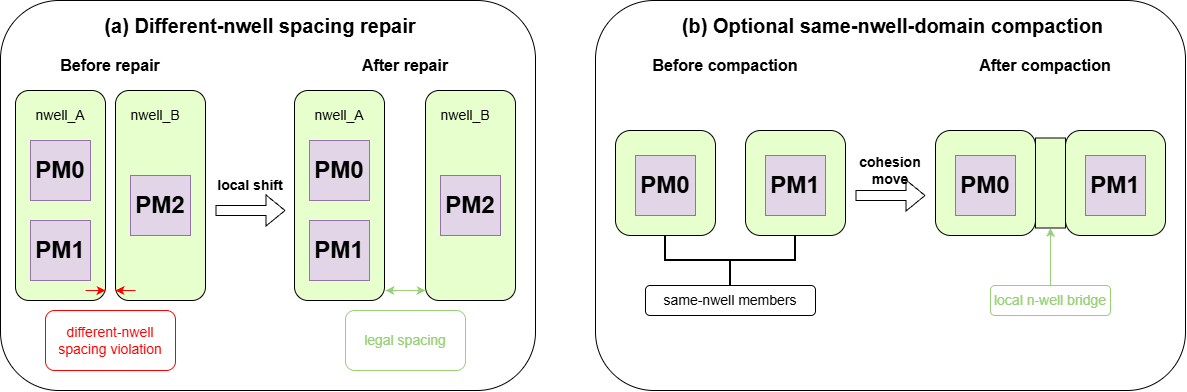
The repair stage evaluates the placed module geometry as a proxy for the corresponding n-well-domain extent and locally shifts modules or domain member groups to reduce remaining different-nwell spacing violations.
Candidate repairs are selected conservatively so that legalization does not unnecessarily destroy an otherwise compact placement.
After different-nwell spacing has been repaired, an optional same-nwell cohesion pass can move members of a shared n-well domain closer together.
This second pass supports:
- compact same-nwell islands;
- reduced white space between same-domain modules;
- local n-well bridgeability;
- preservation of useful stage-local proximity where possible.
The resulting sequence is therefore:
multistart B*-tree search → different-nwell spacing repair → optional same-nwell-domain compaction
Why Well Repair Is Separate
Inflating every PMOS module with a large fixed n-well keepout would make different-domain spacing easy to enforce, but it would also separate modules that intentionally belong to the same n-well domain.
That would work against the desired behavior for same-domain PMOS structures, which may need to remain close enough to form one compact physical well island or to be connected by a short local n-well bridge.
The adopted flow therefore distinguishes:
- different-nwell domains, which require legal spacing;
- same-nwell domains, which may benefit from compact alignment and bridgeability.
This distinction is carried from the module representation into placement and the subsequent repair stage.
Placement Flow
The complete placement sequence is summarized below.
The repaired placement is then passed to hierarchical assembly, where placement-dependent well connections and top-level routing can be added.